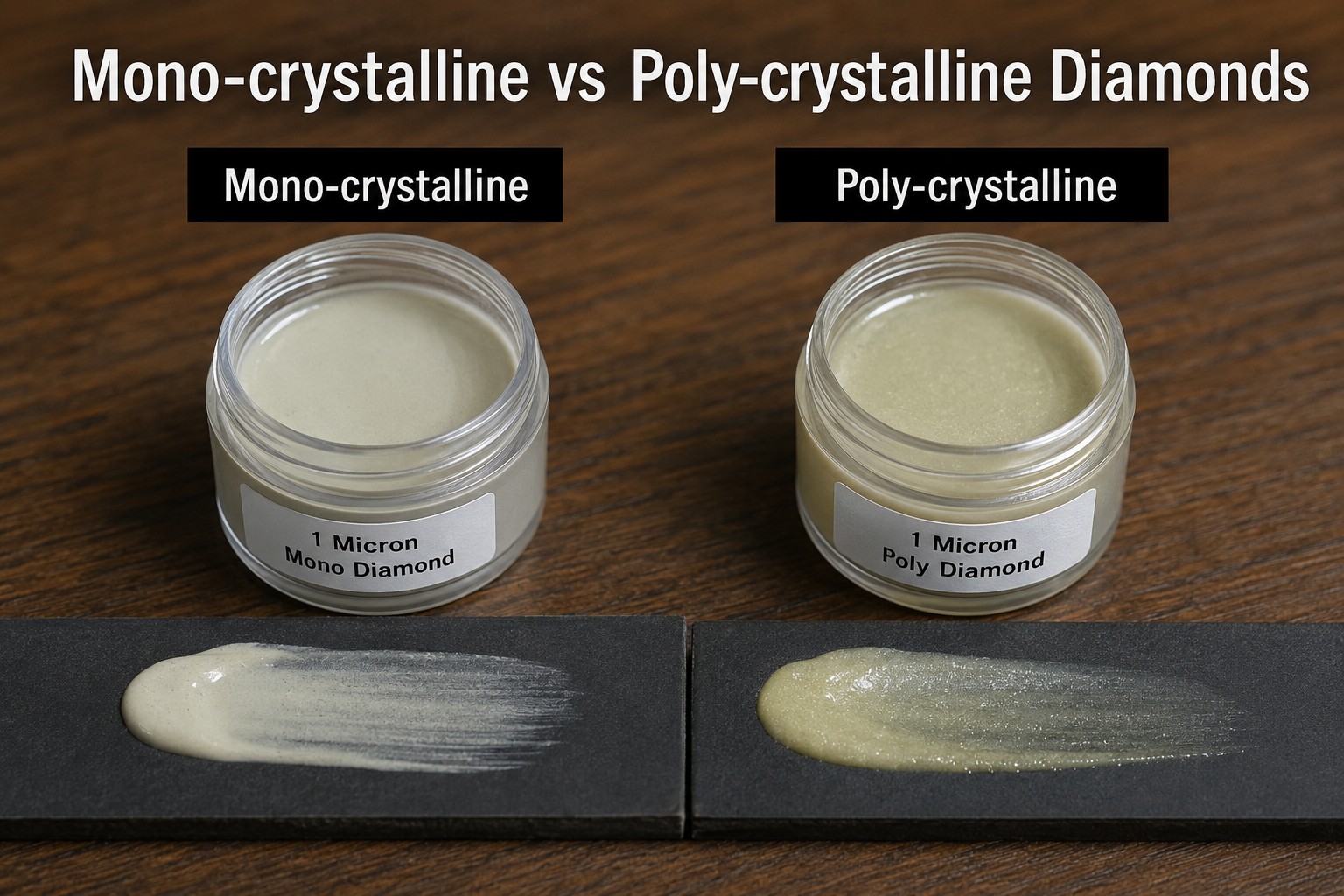
Mono vs. Poly Diamonds and Emulsions Explained.
Here are some answers to common queries about the differences between Mono-crystalline and Poly-crystalline synthetic diamonds and emulsions containing these two different abrasives.
Specifically surrounding the context of stropping.
Please remember that this information is not for every heavy industrial or high-pressure tooling application these particular diamonds might be found in –
where they both have the potential to behave very differently.
Mono-crystalline characteristics.
Mono-crystalline synthetic diamonds are made in two ways, a High Pressure-High Temperature process and in a Chemical Vapor Deposition process.
They’re known to be practically defect-free and are single-crystal structures more likely to resemble naturally occurring, non synthetic diamonds. One of the reasons their so popular.
Mono-crystallines single-crystal structure makes them larger with much more predictable, defined fracturing plains and are noticeably longer-lasting.
Having naturally occurring cleavage planes in their crystal structure, this allows them to chip in a quite controlled way along these fracturing plains, breaking up during the corse of normal use.
This micro-chipping renews the abrasive function of the diamonds sharp, defined cutting edges, becoming refreshed acting like new diamonds, quickly removing steel like new.
This is done while still maintaining consistency in size to their specified micron rating.
Due to this process they are known to have great cutting performance, giving your blades edge the ability to get, and hold its crisp bite for a long time. They are especially good at making a more toothy, clean and linear, micro scratch pattern on your bevel.
Giving a competently refined, thinned out apex giving a magnificent mirror polish with bite.
Mono-crystalline diamonds aren’t just found in high quality stropping emulsions, but they are commonly used as the sole abrasive found on most diamond sharpening stones, produced by many of todays top-teir diamond stone manufacturers.
This is mainly due to their cutting longevity and overall performance.
Poly-crystalline characteristics.
Poly-crystalline synthetic diamonds are solely manufactured in laboratories, meaning by default their quite more expensive to produce then Mono-crystalline diamonds and because of this are comparatively less common.
These diamonds are characterised by clusters of countless incredibly small diamonds that are bonded together to form complex, random unpredictable shapes and cutting edges – like miniature fragments of shattered safety glass.
They’re known to cut fairly aggressively at first due to their inherent extreme hardness. Also, their mutli faceted – meaning they have multiple cutting edges but that are multi-directional – just one diamond can bite into the bevel multiple times, in the same single pass.
The downside is a less refined cleanly stropped edge giving somewhat unpredictable results.
In theory, these harder bonded diamonds facets are more friable breaking apart over time when stropped with into new smaller cutting particles – though these renewed edges produce irregularly shaped, tiner diamonds.
In practice though, they’re extremely tough – much too tough and hard-wearing to fracture and break down into new fragments under the applied pressure produced by the amount of force applied by any method of stropping.
Due to their hard, small, wear-resistant particles they give a softer progression and these attributes mean they leave a pronounced, smoothed-out bevel and after some time their small size means you loose material with the fine fragments becoming dislodged from the surface of the strop.
It must be noted that they too, also leave an extraordinary polished cutting edge.
These diamonds can be found in other applications like stone masons or jewellers and their associated tools, or industrially on drill and router bits and grinder cutting discs
Where high hardness and wear resistance is preferred.
Below are some condensed dot points and a summery of their main differing attributes –
Mono-crystalline diamonds.
- Each particle is a single, solid crystal, with their own defined cleavage planes and naturally shaped, sharp edges.
- As they wear from stropping, they break along their natural fracturing planes, constantly exposing fresh, keen cutting edges.
- The edges cut cleanly, slicing into hard steels efficiently, with concentrated, linear scratch patterns.
- Excellent for longer, fast and consistent material removal, giving refined mirror polished edges that hold their crisp bite over time.
Poly-crystalline diamonds.
- Clusters of countless, micro, synthetic diamond particles bonded together with multi directional cutting edges.
- Under very high pressure can be broken down into even finer particles.
- Theoretically creating new micro-edged fragments, smoothing and polishing the steel, rather than cutting and refining it, due to their inherent hardness.
- Good for touch-ups and high mirror finishes, giving the polished cutting bevels a smoothened surface.
“There is no doubt these two synthetic diamonds are the pinnacle of micron abrasives used for stropping.
They will give you the best edges with the cleanest, most refined apexes possible. Ultimately it just comes down to your budget and personal preference.
whether you go with Mono diamonds for fast, clean cutting particles, giving a refined progression, leaving a linear scratch pattern, that has a crisp bite and remarkably polished edge or whether your wanting smaller, harder, wear-resistant, finer cutting particles that are gentle on your edge, giving a soft progressions, with a multi-directional striations that produce more of highly polished, particularly smoothed-out bevels using Poly diamonds.